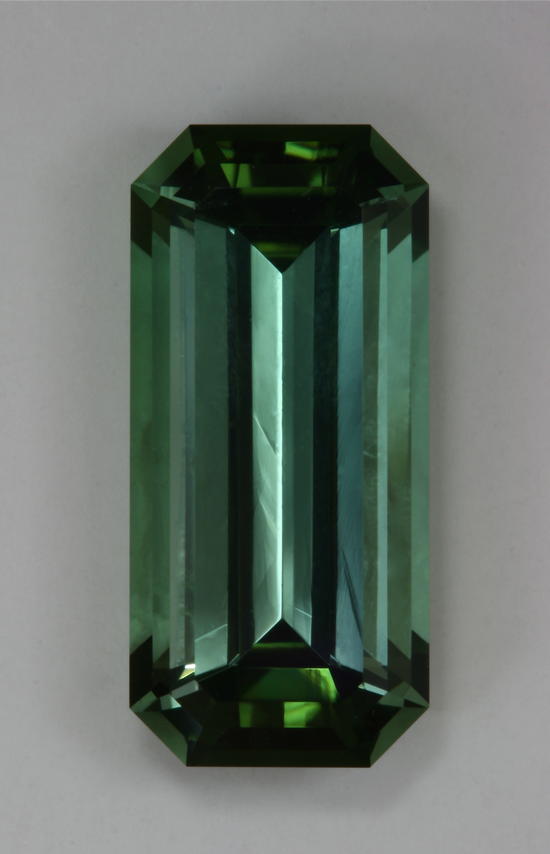
 This stone changes/shifts it color from green to blue and has normal angled ends, despite having dark ends. The gem is clean and weighs 5.03 carats.
This green emerald cut is longer than I would like with its narrow width. I generally do not get much rough that is dark in the ends and the crystals are too short to be split into two or not thick enough to make a nice ratio gemstone. A short stubby crystal section with a dark c axis is pretty useless in the tourmaline world. Now most experienced cutters will tell you that to get the most out of a tourmaline with dark/closed ends you need to cut an emerald cut with steep angles at the narrow ends of the emerald cut, that has a decent ratio between the length and the width. Well with this very nicely colored green emerald cut, I cut the end with the same angles as the sides, which are pretty standard by now. This makes the stone have somewhat bigger dark ends than absolutely necessary, but I find the normal cut to have more flash in the corners, which are cut down less and makes a stone that can be set easier. I know this is personal, but I don’t think I hurt a stone like this very much, because of darker ends, to cut it with normal angles.
News flash. Long ratio green cut emerald cut singing the blues. I am writing this post at one of the best time of the day to see color in lighter colored/pastel tourmaline gemstones. The sun has set, but the sky is still bright. Not only does the tourmaline seem to absorb and be enriched by the remain, glare-free, light, but some tourmaline play color tricks. Well this gems stone has turned out to be a jester and went blue on me. I can see that I failed to test this beauty out enough when I finished cutting it. I am not saying that changing from a green to a blue in the tourmaline world adds much value, but to me it is exciting example of the dynamic world of color in tourmaline.
The posted gemstone weighs 5.03 carats.
Bruce
