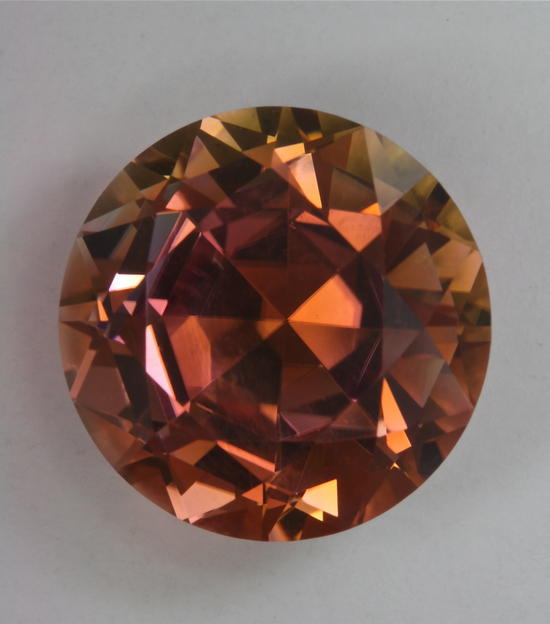
 This deep horizontal split main cut shows of the mixing of pink and yellowish green to make orange. It weighs 9.87 carats and is clean and very bright.
True or False. Pink and green light mixed together with the right level of tone makes YELLOW.
True and the story goes on.
In the tray this large round with a pavilion consisting of eight split mains and a crown with a standard brilliant cut looks orange. An orange that is fresh and tasty ,like just squeezed Florida orange juice. It is pulp free and the clear juice does not turn brownish in different lights. Now this is wonderful for a tourmaline, but it bears closer investigation. Swirling the stone allows the eye to pick up some yellowish green flashes at the girdle. Turning the stone over, which is usually the best way to see color distribution in a faceted tourmaline, reveals a pink body with a slight peach over tone. What is going on? Now I cut this stone and that means I looked at it pretty hard and I know that there are really only two colors in this clean deep round, pink and yellowish green. The yellowish green that you see when you swirl the stone face up and the pink that is seen when you turn the stone over. I think that you don’t see the yellowish green on the pavilion side because even on the back, the stone has some mixing and the culet and girdle areas where the yellowish green color is, are mostly just pale. So where is the orange, it is in the mixing of the colors. This is such a great example of the power of faceting and the beauty of tourmaline’s color. I personally don’t think that this tourmaline’s display is as appreciated as it should be in the world of gemstone values. (It should be worth more.)
This is a classic combo from Nigeria that I first saw when they found the big discovery of tons of rubellite and pink tourmaline around 1990. Ah, those were the days. Well this gemstone is a beautiful example of a more recent find that keeps me hanging in there.
Bruce
