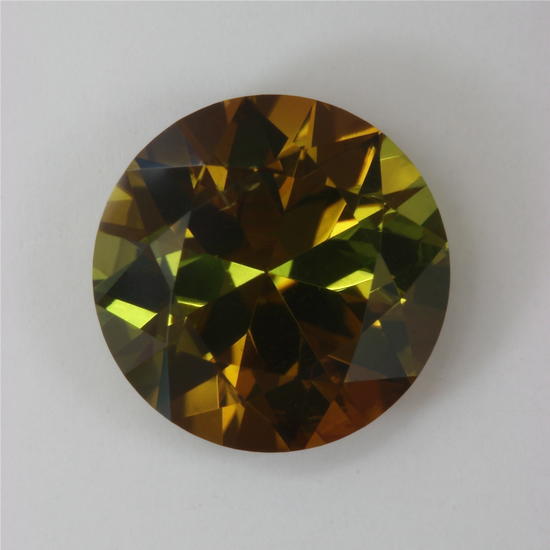
 This standard round brilliant has two slices of a/b color and two slices of c axis color. The lack of mixing keeps the round from being muddy. The clean stone weighs 3.31 carats.
This standard round brilliant makes me smile. It takes me back to my very early days on the internet when I had found a dealer who cut some tourmaline down the long axis of smaller alluvial pebbles. I asked him why and got rather a run around and then I cut them. It did not take long to realize that cutting them down the long dimension had made the rough appear very much nicer than it was, by minimized the dark color of the c axis. Now when cutting a tourmaline you can have the c axis completely dominate the paler a/b color, but you can never eliminate the c axis color. Now I have to qualify that. If you’re willing to cut ninety degree ends on emerald cuts the c axis could be cut out, but that is not acceptable to me.
The gem I am looking at is not from that dealer, it is too big and too nice, but it has the classic slice of pie color distribution. By cutting the table parallel to the c axis (on the side of the crystal), you get alternating areas of a/b color and c color for a total of four slices. People are surprised by this arrangement, but it is easy to do and it can make a pretty stone. In this case it is not my favorite combination, yellow green and gold. Not to give up hope for this bright pleasant gem, the mixing, even in a round, is very limited and the stone is not muddy. This clean standard round brilliant weighs 3.31 carats.
Bruce
Bruce
