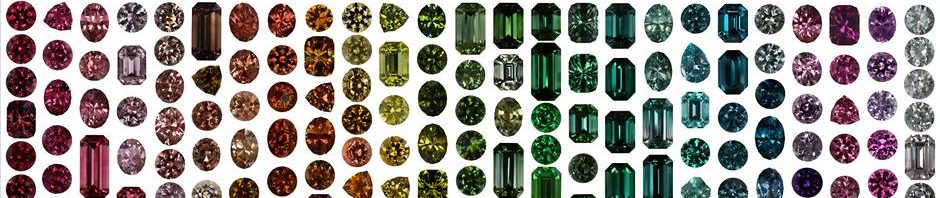
I just finished a pink oval from a piece of tourmaline rough from Nigeria. It turned out to be one of the most fragile pinks I have cut. And this is from a location that has produced very calm and collected rough that was some of the easiest to polish I have found. It made me think of the physical properties of the pink group, which is one of the most common colors in tourmaline.
There seems to be a consensus that natural and or man made radiation is necessary to produce the chromophore manganese +3 that is the probable cause of the red tones in tourmaline. I say probable because color centers, which are defects in the crystal structure that are not tied to impurities has not been completely ruled out as a factor in the red coloration of tourmaline. I am talking about Elbaite and Liddicoatite now since there is a red dravite/uvite that is colored by iron and is a completely different story. (I recut a gemstone out of red dravite for a jeweler one time and it was as close to ruby red as I have ever seen in tourmaline. I wish that I had bought the gemstone from him since I don’t have an example in the collection.)
Unfortunately the irradiation seems to do more than color the tourmaline red. In some cases it seems to in brittle it. Now many red and pink tourmaline have inclusions and flawless stones are rare from many locations, but having inclusions doesn’t mean that the stone will be brittle. I have found dark pinks and reds tend to undercut when you polish a table that is perpendicular to the c axis, but again this does not mean that the gemstone is brittle. In fact I don’t think that you can tell a pink or red tourmaline is brittle by looking at it. I certainly find out fast enough when you try and polish the keel. I try and minimize chips by using my well worn 3000 lap on critical facets, a lot before polishing, but I have not been completely successful in eliminating chips with brittle tourmaline.
I personally think that some tourmaline crystallize from a source with the manganese +3 chromophore already formed. This does not seem to be supported by the most recent work done on the temperature at which tourmaline crystallizes in a pegmatite, but it would explain why some pink and red tourmaline is extremely stable while other pieces are not. The level of manganese and the intensity of red in a tourmaline have been shown to independent of each other. So other factors such as the amount of radiation must be significant in producing the level of red in some cases. Another factor may be the level of recepters for the electrons, that are produced by the oxidation of the manganese. The gemstone must maintain neutrality after being irradiated and if there is no place for the displaced electrons to be neutralized in the tourmaline, they will recombine with the manganese +3. This produces manganese +2, a very week chromophore in tourmaline. In other words, even a lot of irradiation and ample amounts of manganese can not produce the ultimate red tourmaline in many cases.
If I was buying a faceted pink tourmaline, I would check for chips. If you see many, it might mean that the stone will be hard to set. I have had a couple of medium “hot” pinks crack on me during the setting process.
Bruce
