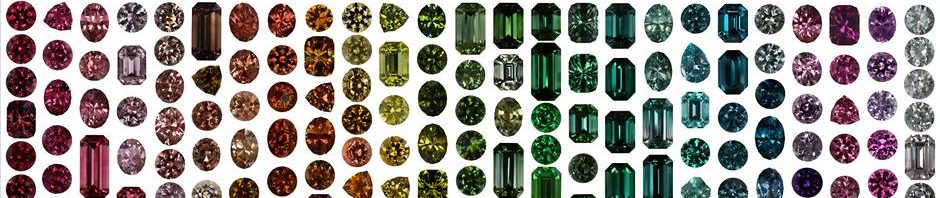
The investigation of color in tourmaline and what causes it is complex. Many investigators have proposed causes for the colors in tourmaline, but have either been unable to prove the conjecture or proven wrong. In the case of the red tones in tourmaline it has been widely reported that it is cause by the higher oxidation state of manganese Mn+3 and is amenable to enhancements by man. Some authorities have proposed other causes such as color centers, (A distortion in the electronic structure of a crystal that can express color.) But for the purposes of this post I will focus only on manganese and two of its oxidation states Mn+2 and Mn+3. Mn +2 has lost two of its electrons while Mn+3 has lost three of its electrons. In nature Mn+2 can be made to loose an electron and become Mn+3 by being exposed to radiation over geologic time. Heating the gemstone can reverse the process and colorize tourmaline that is colored by Mn+3 by reducing it to Mn+2. (by accepting an electron.)
I am convinced that Mn+3 is the principle chromophore (an element that cause color to be expressed in a gemstone, plastic, etc.) in most, if not all the tourmaline (Elbaite) that has been investigated. I am also convinced that most red tourmaline (Rubellite) does not have its full compliment of manganese oxidized to Mn+3. This might lead you to the conclusion that man with his technology can oxidize all the manganese in a tourmaline to Mn+3 and perhaps enhance its color/tone values, but this has not proven to be the case.
The inability to perform the same act of color magic that transforms colorless topaz into glorious colorful gems, with tourmaline, has several reasons. Two of which are fundamental to all chemical reactions.
!, The total process must be electrically neutral. The tourmaline can not get and maintain a high percentage of Mn +3 without some location in the body of the tourmaline accepting the excess electrons, release by its oxidation from Mn +2 threw irradiation. This electron accepting location in tourmaline is presently unknown.
2, In a chemical reaction the reagent that has the lowest amount available to support the reaction determines the final concentrations of the reaction’s products. In other words, more manganese in a tourmaline will not enable irradiation to permanently oxidize it to Mn+3 unless the concentration of the manganese was the limit on how much Mn+3 was originally there.
3. Most tourmaline appears to have had enough Mn+3, when it crystallized out of the magma or been irradiated over geologic time by a natural isotope of potassium(certainly could be in combination) to already have its maximum level of Mn+3 and the commiserate level of red color,hue before man’s intervention. (This is just an empirical observation that is certainly open to further investigation with the modern analytical tools.)
So if most of the available tourmaline is already as red/pink as it will ever get without anything being done by man, then why is it heated and irradiated in the trade? To help get rid of undesirable over tones and make the color more saturated (purer). As I understand the process, first the tourmaline is heat to decolorize it and then irradiated to reintroduce a red color. This process does not fundamentally change the tourmaline’s need to remain neutral or more accepting of the electrons produced by irradiation.
I am personally pleased that the following did not happen in the world of tourmaline because of the chemical limitations I have discussed.
1, The market will not be flooded with red red tourmaline that was produced by processing pale pink tourmaline (we don’t have much colorless material like topaz, but do have tones of pale pink.)
2, That a bright red tourmaline (Rubellite) that dances in the light because it has a bit of an overtone is probably a natural beauty and that no amount of processing by man can really enhance it.
Bruce
