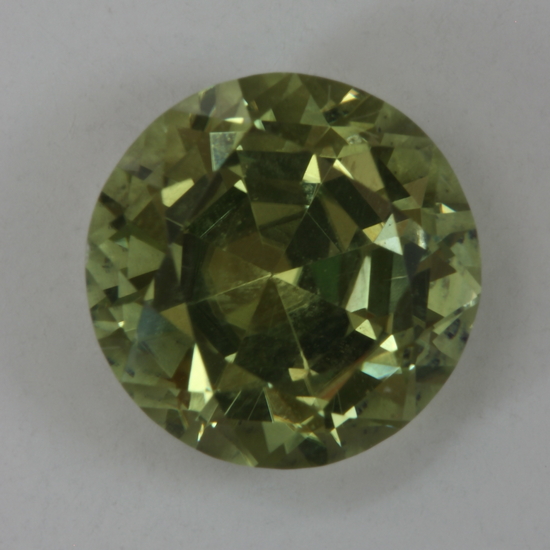
 This round is eye clean and very flashy. Its color has just a trace of green in it It has a nice medium tone level, which was helped by horizontally cut mains on the pavilion. It weighs 2.71 carats.
Once upon a time I had a roommate, during my freshman year at college, that appeared to have pink underwear and socks. Now this was in 1966 and some social movements had really not come out of the closet. So, after giving it a little time, I became bolder. In disgust, he explained that he had washed all his white laundry with a pair of new purple wool socks and everything came out pink. Now that was enough for me and despite having to listen to his endless pain from a fractured relationship with a girl, we did OK.
Now I feel I have to get bolder with mother nature and wonder why she doesn’t stop washing all my great yellows in with something green, in tourmaline. To get at least a partial answer, we have to look at what I have read about yellow to yellow green in tourmaline. But before I get into the details I would like to present a general idea that was distilled by a research/write after reviewing data dealing with color and the chemistry of tourmaline. The data on the chemistry of tourmaline and color is not consistent unless there are more than one chromophore, coloring agent, for some of its colors. That is my summation of a paragraph or more of grumpiness and pontification.
Now the first thing that must be done to make a yellow to greenish yellow, Elbaite, (I am limiting this discussion to the most common tourmaline in gemstones) is too keep down that pesky iron. Now iron is a very common element in the crust of the earth and it likes tourmaline, so the locations and conditions under which you find tourmaline that is low in iron will be few and far between. Now into the nascent crystal of tourmaline you must add a dollop of manganese and and dollop of titanium. Both of these elements are common in tourmaline so that is not a major problem, but both elements must also be in the proper oxidation stage to form what is called an Inter Valence Charge Transfer reaction. The IVCT is a combination of elements that work together to absorb some wavelengths of visible light and give color to gemstones, where they could not be chromophores (coloring agents) by themselves. So that is the proposed process for the creation of most of the yellow green tourmaline in the world, but not all. In fact I am not sure if this combination of elements is capable of producing a pure yellow or not, but the next tourmaline magic should attain pure yellow heaven.
To make at least one form of pure yellow, you need very low if not zero levels of iron and other significant chromophores like manganese. I don’t think that they directly effect the electronic process, that I am going to try and explain, but they are such strong chromophores that they would dominate the color of the stone, if a significant amount of them were present. Now this colorless tourmaline needs a decent dose of natural radiation to make what is called color centers. Color centers are formed when the electronic configuration of a crystal is change from its idealized perfection, but not its overall chemical make up. In the case of yellow tourmaline, it has been shown that the radiation dislocates a hydrogen ion and the charged area formed in the electronic structure of the crystal is neutralized by the movement of an electron and neighboring oxygen atoms. This configuration in tourmaline is capable of absorbing visible light energy of the correct wavelengths to make yellow. A yellow that is stable enough to part of the reason why tourmaline has the greatest color adventure of any gemstone.
I don’t know if these two mechanisms can exist in a single crystal of tourmaline at the same time or not or what other complexities might exist with yellow color in tourmaline. But I think the production of color centers maybe able to answer one of my eternal questions. What makes some Paraiba tourmaline green? That is a good subject for a whole new post, but I will leave you with this. Because of the lack of thermal stability in some green paraiba tourmaline and the fact that copper alone can not produce green in tourmaline, leads me to believe that the color centers, we looked at above, are the principle cause for green in Paraiba tourmaline when it is low in iron.
A now back to the main event. The posted yellow has just been dipped in a weak green and made deep with a set of eight split horizontal mains. The color is a rather cool and restrained one for a pastel that has had its tone increased by the added depth of the cut. The gemstone appears to be eye clean and of fine crystal. It weighs a very flashy 2.71 carats.
Bruce
