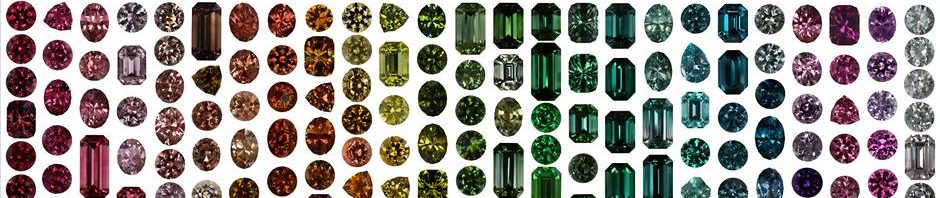
Just got back from a trip down “Cuprian Tourmaline Lane” on the inter net. I really don’t think that the confusion will ever abate when it comes to color, neon glow, vivid color and the composition of Paraiba, paraiba like, paraiba kind and cuprian tourmaline. But I want to comment on one experts opinion when he glibly responded to a question about the glow you find in high quality cuprian tourmaline.
He felt that all “super vivid gemstones” have the glow some people call “neon” displayed by some cuprian tourmaline. His sole example of support for this was ruby. I have seen the effect in ruby and it is wonderful, but it not solely because of its super vivid color, it is also because it fluoresces red under daylight conditions. It is the combination of Ruby’s color and fluorescence that gives Ruby its glowing edge in red.
Paraiba/cuprian tourmaline does not fluoresce under any light and not all cuprian tourmaline need a “super vivid color” to have that neon glow. I have a nearly 14 carat pear shaped Mozambique/paraiba kind gemstone. Its color is cyan, a spectral color that is almost never discussed with Paraiba/cuprian, but is the proper name for the color of a lot of the glowing, high quality cuprian tourmaline. The gemstone has a moderate tone level and good saturation, but is not a “super vivid gemstone”. Still it has a reasonable neon glowing appearance when compared to other cuprian tourmaline with a similar color. I have a more intense emerald cut of about 3 and a third carats, that has a greener blue color, but is certainly not a “super vivid gemstone” and it glows wonderfully.
Since cuprian tourmaline can have that neon glow without being a “super vivid gemstone” or fluoresce, what causes it to glow? After working with a reverse Alexandrite color changing cuprian tourmaline from Mozambique that I call Laurellite (more posts on site), I have put together the following brief paragraph. It sums up my personal attempt to come to grips with the “neon” effect.
The mind/eye is not a camera and it comes programed by evolution to make assumptions about the color properties of objects it sees. One of the assumptions is about color consistency and when the mind/eye is unable to adjust enough to maintain color consistency in certain rare cases, we get color change objects/gemstones. Another assumption is based on a ratio of how much light is returned from an object/ gemstone and its tone level. If too much light (more than the mind/eye expects) is returned from the object/gemstone for its tone level, the mind/eye is fooled into producing the sensation that the object/gemstone is producing light, not just reflecting it.
No matter was causes the neon glow in high quality cuprian tourmaline, comparing rubies and cuprian tourmaline’s visual presence is like comparing apples and oranges. The comparison is not valid because the gemstones have properties that are too different. And the the production of the neon effect is much more subtle than just having an object/gemstone with a”super vivid color”.
Bruce
