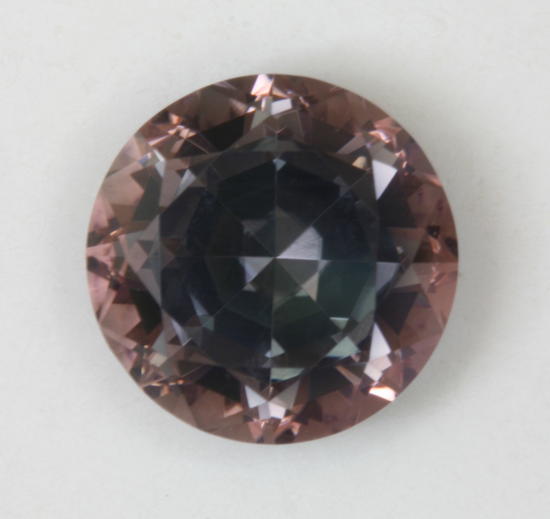
This is not the prettiest tourmaline in the collection and the way I cut the rough crystal, which had a thin, bordering on the opaque, blue cap, was frankly an experiment. When I first received the rough from Africa it was easy to orient it and see that the intense band of blue was the crystals terminus. Now what to do with a very tourmaline, tourmaline, that nature had not really designed for faceting. I think the most conventional way would be to place a tiny amount of the blue in the culet and let the color fill the stone, but that would not yield a very large gemstone in this case. Besides if I let the flat blue terminus be the table of the round brilliant, I could control the amount of blue I left in the gemstone better. And I had never done this extreme a color job on a crown before, so let the games begin.
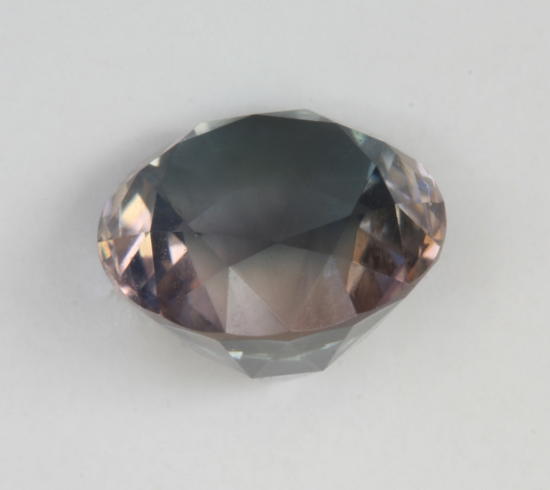
The pavilion of the brilliant went easily as expected. Strange peach is a color that has never given me problems in either the cutting or the polishing phase. I probably should not use the adjective “strange” for the gemstones body color, but it is a rather grayed fleshy color that is hard to describe ( the second picture gives you a pretty good view of it). I have other tourmalines with a similar color. After turning the gemstone I started playing with grinding the table. I generally set the angles for the mains on the crown first, to try and accommodate different tone levels and the thickness of the rough I have to play with. I like about 40 degrees for the mains, but in this case I was willing to let the transparency of the blue band determine the thickness of the crown. And the layer was dense and the grinding continued. I was concerned that the properties of the flat terminus (weakness and undercutting during the polishing) could cause problems in the cutting and polishing of the table, but it did not turn out to be a problem.
After grinding more than I expected and with a growing concern that I might grind so much of the blue band away that I would have a gemstone with an uneven color, I stopped. I could see clearly that some of the blue was mixed into the body of the stone, but the level of tone changed so abruptly that it left me little room for error. As you can see from the first picture the stone is still pretty dark and I think the blue band causes the lack of flash in the picture. The second picture shows the body flashing as normal and when the stone is rocked, you do see flash from around the girdle. So what do you think, it made a good post and is unique and we shall move on. If I ever get a similar piece, which is unlikely, I would cut it with a touch of blue in the culet.
Bruce
