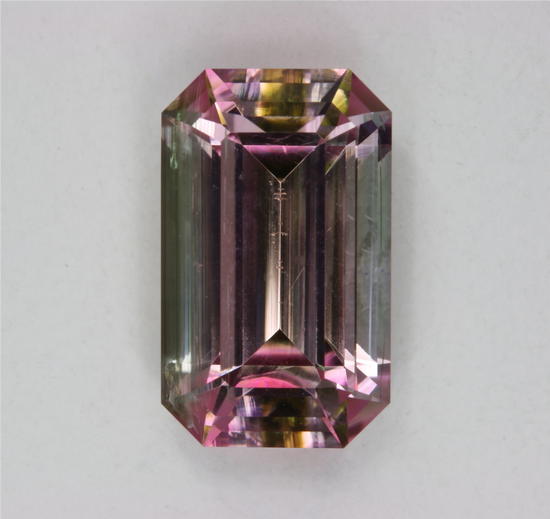
 Bands of color come from cutting a watermelon tourmaline with its table parallel to the c axis.
This smaller emerald cut looks like it consists of bands of bluish green on either side of a pinker band running the length of the emerald cut, where the ends have a much more intense pink color. Except for the ends, the pastels are mild and the best time to look at this stone is just after sunset when there is still plenty of ambient light, but no glare. I have found that all tourmalines, with a pastel tone level, like the same conditions. But in this case, the stone is so complex, that it really is powered up under the bright indirect light.
Why does the gemstone appear to be so complex? Because it was cut, like the first cut down the long dimension of a juicy watermelon. The long dimension in a tourmaline crystal is generally the c or principal axis. The rind was then mostly ground off the keel of the gemstone during cutting, while grinding the table removed any rind under it. The conditions ((The rind must be clean enough and thick enough, without being overwhelming, to be retained on the gemstone. The core must not be too intense and clean enough to facet.) under which this type or orientation works on a watermelon is pretty difficult to find and this gemstone is unique in the collection.
I was fortunate that everything held together on this one.
Bruce
