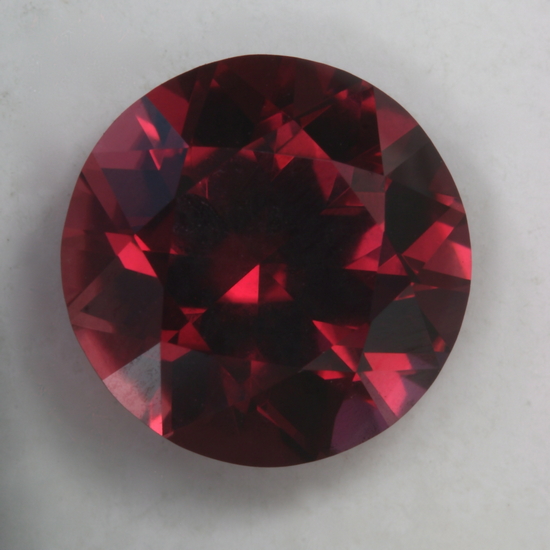
 This standard round brilliant appears to be eye clean and with fine crystal. It has a significant amount of brown, in its red, under some white lights. It weighs 2.79 carats and may be unique in the collection.
This is the “red” that goes brown. (maybe call it red)
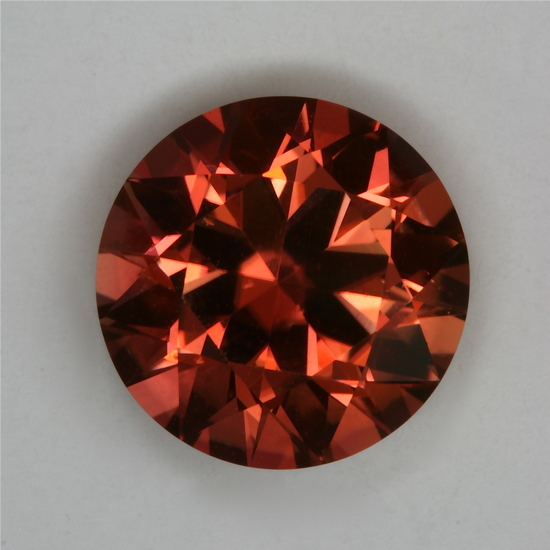
This is the “red” that goes orange (maybe call it color changer)
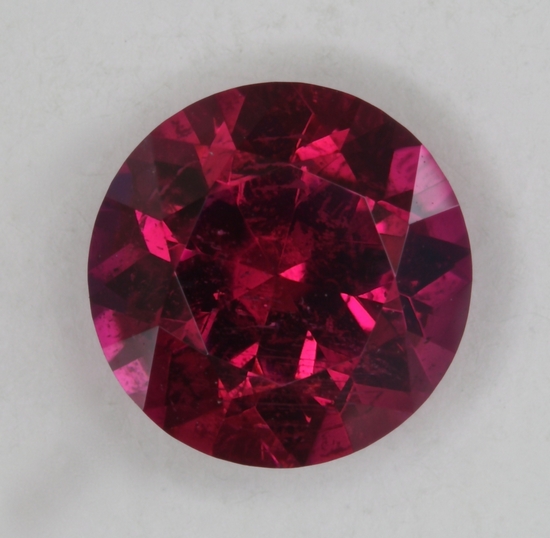 This standard round brilliant red and that is all it ever is, red. It appears to be eye clean and bright enough to really show off its red color. It weighs 1.23 and is a fine droplet of color and is a Rubellite.
This is the “red” that is stable. (maybe call it Rubellite)
Metamerism is when two color samples, each with different spectral characteristic produce the same color sensation under certain lighting.
Metamers are two spectrally different color samples that produce the same color sensations.
Now these works are relatively new in my vocabulary, but the concepts are essential to understanding color in tourmaline and why just red for red tourmaline or green for green tourmaline etc. is not enough.
I can show you with my spectrometer that the differences in absorption in the visible range between two red tourmaline can be significantly different, but because of metamerism they can appear the same hue (color) under certain lights.
I have pulled out three “red tourmalines” from the collection that are not completely identical under my lighting conditions, a twisty miniture florescent light in a yellowish shade, but all would easily be called red with similar tone values, by me. The one I am posting will go brownish under incandescent light, the second gemstone will go orange under incandescent light, while the third gemstone will be stable. I could continue this exercise with reds that go purple under some lighting conditions, but three is enough to post here to demonstrate my point. These three reds are metamers, and just calling them “red” is inadequate to describe the very different response each one has to different, reasonable, everyday lighting conditions. The posted stone that goes brownish red could be called red, while the one that goes orange could be called a color changer and the final stable one could be called Rubellite if you want to pass on enough information in a name to judge the stones color. (color names are just my suggestions and are sort of in line with the Trade) Red is not enough.
I love the posted gemstone. It stands in the middle, under some lighting conditions (incandescent) between a nice Rubellite that has a stable red and reds that are so rich in brown that I call them Mahogany. It has a medium dark tone and a nice flashy disposition even in its brown phase. It appears to be eye clean and with fine crystal. It weighs 2.79 carats and I think is unique in the collection.
Bruce

Pingback: Rich pink with orange tones oval. | The Bruce Fry Tourmaline Collection
Hi Bruce – your commentary about when is red, red strikes home.
I’ve struggled with the definition of rubellite vs. pink tourmaline, because much of the deep/hot pink tourmaline I’ve purchased has been sold to me as rubellite. Clearly, when comparing with your stones I only have one true rubellite (a stunning one at that) but the rest are varying shades of pink.
I’d like to hear your comments about the color-shifting pink tourmalines that come out of Nigeria – those that are bright hot bubble-gum pink in flourescent, but turn a golden peach in tungsten. Your collection contains quite a few of them so it would be nice if you could write an article specifically about them.
Thanks for posting your stones and comments – a truly stunning collection of tourmaline!
-Allan